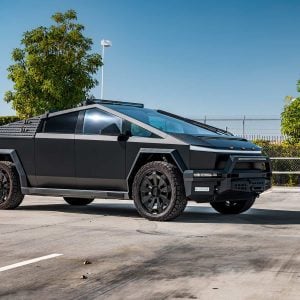
Elon Musk made it official on X this week: Tesla will wind down Cybertruck production at Gigafactory Texas around mid-2027 to make room for more Cybercab output. The stainless-steel pickup that was once pitched as a 250,000-unit-a-year product is handing its floor space to a two-seat robotaxi with no steering wheel. Anyone who has watched the sales numbers saw this coming. The more interesting question is what Tesla does with everything the Cybertruck program taught it. My answer is simple: build the big family SUV people keep asking for, and this time, resist the urge to make it look like a polygon.
The Numbers Never Lined Up
Tesla lists installed Cybertruck capacity in Texas at more than 125,000 units a year. Actual US sales, based on Cox Automotive and Kelley Blue Book estimates, came in at 38,965 in 2024 and 20,237 in 2025. This year has been worse: 3,519 in the first quarter, 3,744 in the second and 4,323 in the third. That puts 2026 on pace for roughly 16,000 trucks, about an eighth of what the line can build. Reports also suggest roughly one in five recent Cybertrucks went to Musk’s own companies, including SpaceX. The cheaper all-wheel-drive trim nudged things up, but nowhere near enough.
Musk didn’t say whether the truck moves to another plant or simply fades out, and Austin is reportedly the only Tesla factory tooled for its specialized parts. Lead engineer Wes Morrill called it a “handoff,” saying the truck’s technology lives on in Cybercab. That framing is generous, but it isn’t wrong. The Cybertruck’s problem was never the engineering. Steer-by-wire, rear-wheel steering, the 48-volt low-voltage architecture, and the high-voltage pack are genuinely advanced. The problem was the packaging: too strange for mainstream truck buyers, too expensive for fleets, and never sold in Europe at all.
The Aftermarket Already Voted on the Platform
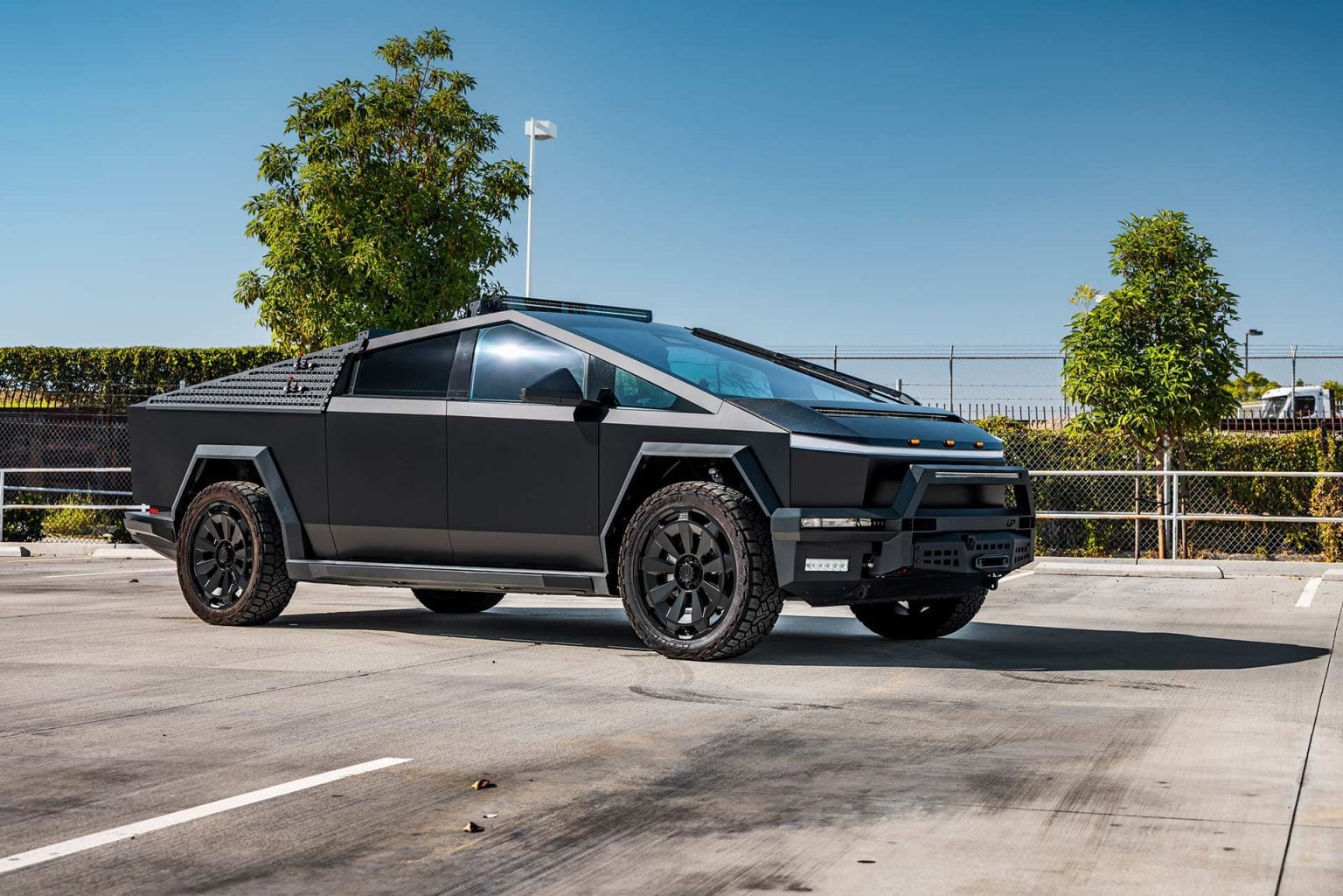
If you want proof the hardware underneath is worth saving, look at how seriously the aftermarket has taken it. Unplugged Performance, the Hawthorne-based tuner best known for its Tesla suspension and brake upgrades, built an entire Cybertruck program called UP INVINCIBLE. It covers heavy-duty steel bumpers, rock sliders, carbon fiber body panels, high-output LED light bars, MOLLE bed storage, and a range of forged wheels, including the CYBRHEX, CYBRSPOKE, and the purpose-built UP-03 Beadlock. Its 2.5-inch lift kit, priced at $9,995, took more than two years to develop, and a prototype ran on the only Cybertruck entered in the Mint 400 off-road race.
How that kit was engineered is the telling part. Instead of overriding the factory systems, it works with the Cybertruck’s air suspension, ride-height sensors, steer-by-wire, and rear-wheel steering. The CYBRSHOCKS rear secondary shock kit follows the same philosophy, adding damping control on top of the OEM setup rather than tearing it out. Serious aftermarket companies don’t spend years of research and development building around a platform they consider fundamentally flawed. You can argue all day about the exterior, and plenty of people do, but the people who actually take these trucks apart keep reaching the same verdict: the chassis, suspension hardware, electrical architecture, and drive units are seriously good. That is exactly the kind of foundation you don’t throw away.
Why a Conventional CyberSUV Makes Sense Right Now
Tesla has a hole in its lineup. The Model S and Model X ended production earlier this year so Fremont could be retooled for Optimus, and Tesla now has no true flagship three-row SUV. The stretched three-row Model Y L helps, but it is still a Model Y with a longer wheelbase, not a full-size family hauler. Back in March, when a fan asked for a minivan, Musk replied that “something way cooler than a minivan is coming.” A clay model shown in Tesla’s 2025 Sustainable Abundance video pointed at a Cybertruck-derived SUV.
Here is where Tesla needs to be smart. The expensive part of the Cybertruck- the drivetrain, the electrical architecture, the steering and suspension tech- is already developed and paid for. Put that hardware under a body a family in Dallas or Munich would actually buy. Drop the stainless exoskeleton for conventional stamped panels, give it a proper third row and a flat load floor, and design it to meet pedestrian-safety rules in Europe and China from day one. Make it distinctive, sure, but distinctive the way a Range Rover is distinctive, not the way an art installation is. The target list writes itself: Cadillac Escalade IQ, Rivian R1S, Volvo EX90, Kia EV9 and Hyundai Ioniq 9.
Projecting the Sales
These are my own estimates, not Tesla guidance. Assume a conventionally styled CyberSUV starting around $70,000 for a dual-motor Long Range, with a tri-motor version above $90,000, sold in North America, Europe, China, and the Middle East. A partial first year on a ramping line would land somewhere around 25,000 to 35,000 units. Once production is mature, I think a sustained run rate of 70,000 to 100,000 units a year globally is realistic, with North America taking about half. That is four to six times the Cybertruck’s current pace, and enough to keep a line the size of the Cybertruck’s busy.
The low case is about 40,000 a year if Tesla prices it above $90,000 and launches it only in the US. The high case goes past 120,000 if Tesla offers a sub-$60,000 rear-wheel-drive version and gets it to market before the three-row competition matures. Either way, a family SUV fishes in a much bigger pond than a polarizing luxury pickup ever could, and an aftermarket ecosystem that already knows the underpinnings would be ready with upgrades on launch day.
The Six-Car Lineup Tesla Should Be Running
Step back, and the ideal Tesla range is obvious. At the top sits a flagship sedan, the spiritual successor to the Model S that built the brand’s reputation. Below it, the Model 3 stays the compact sedan benchmark. The Model Y keeps doing what it does best as the mid-size SUV that pays the bills. The CyberSUV becomes the large family hauler and the true Model X replacement. A revamped Cybertruck comes back as an honest work truck: cheaper, simpler, with a conventional bed and a spec sheet aimed at contractors and fleets rather than influencers. The demand signal is already there, as Unplugged’s public-safety fleet brand UP.FIT offers forged heavy-duty Cybertruck wheels for exactly that kind of duty. At the very top, the Roadster, finally revealed on October 15 with production targeted for 2028, serves as the halo car.
That is six vehicles covering every segment that matters, and Tesla arguably still has the best battery and powertrain technology to fill them all. BYD and CATL have closed the gap on cell cost, and nobody should pretend otherwise. But no other automaker combines in-house motors, industry-leading efficiency, mature thermal management, its own cell production, and the Supercharger network in one stack. Wasting that on a two-car lineup with a niche pickup and a sports car three years out is leaving money on the table.
The Bottom Line Is Clear
Tesla’s leadership has made it clear the future is autonomy and robots, and Musk has described the Roadster as the only non-autonomous vehicle Tesla plans to make. Fine. But the Cybercab is designed to be owned and run by Tesla, not sold to you, and robotaxi revenue isn’t close to replacing car sales yet. Cars fund the robots. Letting the Cybertruck’s line go to Cybercab is the right call. Letting the Cybertruck’s technology go to waste would be the wrong one. Build the CyberSUV, make it look like something a normal family would park in the driveway, and bring the truck back later as the tool it should have been from the start.